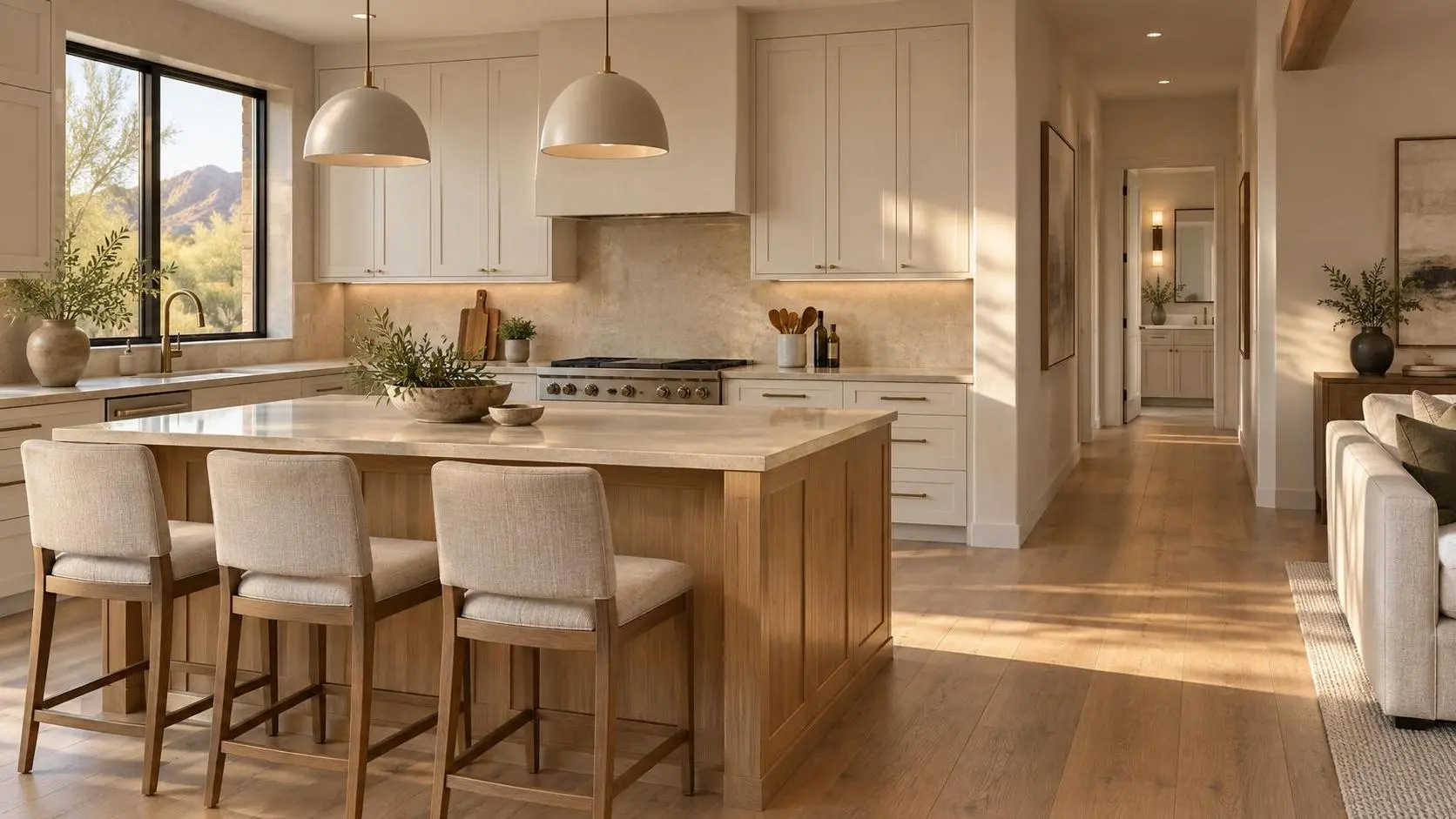


The best window treatment for Arizona sun is chosen window by window, not room by room. Start with orientation: west and southwest glass needs the strongest afternoon control, south glass is often helped by overhangs, east glass needs morning glare control, and north glass mostly needs privacy and softness. Then match the treatment to the problem that window actually creates. Solar shades handle glare while keeping the view, shutters and lined fabrics block more heat and light, and a two-layer setup covers both daytime sun and nighttime privacy. Fading, motorization, and mounting decisions follow from that window-by-window assessment, and they are easier to get right before anything is ordered.
Quick Answer: Matching the Treatment to the Window
West and southwest windows take the hardest exposure, low-angle afternoon sun that roof overhangs rarely stop. They usually need a tight-weave solar shade, a shutter, or an exterior screen, often paired with a softer interior layer. South windows see high summer sun that overhangs can block, so a medium-openness solar shade or a lined roman shade is often enough. East windows bring bright but cooler morning light; a more open solar shade or light-filtering fabric keeps breakfast rooms comfortable without dimming them. North windows rarely get direct sun, so the decision shifts to privacy, evening softness, and how the treatment finishes the room.
Within each orientation, four criteria decide the choice: glare (can you sit, read, or watch a screen comfortably), heat gain (how much solar warmth reaches the room), privacy (day and night are different problems), and view (how much of the outdoors you are willing to soften). No single product wins all four, which is why the order of priorities matters more than the product category.
Start With a Window Exposure Map
Before comparing products, the studio maps every window on the same page: its orientation, the hours it takes direct sun, what the room is used for during those hours, and what sits in the path of the light, such as a sofa, a rug, wood flooring, artwork, or a television. A west-facing family room that is empty at 4 p.m. is a different problem from a west-facing home office in use all afternoon.
The map turns a vague goal like blocking the heat into specific calls. It shows which windows need maximum control and which only need privacy. It flags glass where furniture and floors will fade first. It reveals tall or clustered windows where operation will be inconvenient, and it shows where one consistent treatment can run across an elevation so the house reads as a whole instead of a patchwork of fixes. In new construction and remodels, the map also tells you where to plan blocking, recess depth, and power before walls are closed.
How Drapery, Shades, and Shutters Compare
Solar shades are woven roller shades that filter light rather than block it. They are the strongest tool for glare when you want to keep the view, and they reduce some heat and ultraviolet (UV) exposure, the invisible part of sunlight that drives much of the damage to interior finishes. Their weakness is privacy after dark.
Roller shades in solid or blackout fabric block far more light and give full privacy, at the cost of the view while lowered. Roman shades bring softness and pattern; lined versions control light well, but the folded fabric stacks at the head of the window when raised. Cellular shades use honeycomb pockets that trap air, which gives them better insulating value than most single-layer fabrics.
Shutters offer adjustable louvers that can be angled against low sun while still admitting daylight, and they read as architecture rather than fabric. On hard west exposures, composite or polymer shutters tend to hold up better than painted wood. Drapery is the most flexible for softness, acoustics, and proportion; on its own it is a moderate sun-control layer unless it is lined, so it often works best over a functional shade.
What Openness Percentages and Linings Mean
Solar shade fabrics are rated by openness, the percentage of the weave that is open space. Lower numbers mean a tighter weave: more glare control, more UV filtering, and more daytime privacy, but a softer, hazier view. Higher numbers keep the view crisp and the room brighter while letting more light and heat through. In practice, roughly 1 to 3 percent suits harsh west exposures, offices, and rooms with screens; around 5 percent is a common balance for living and dining areas; and 10 percent is best kept for gentler exposures where the view is the priority.
Fabric color changes the result as much as openness. Darker fabrics usually preserve a clearer view and cut glare better, while lighter fabrics reflect more heat but can glow when the sun hits them. Ask for samples in both and test them on the actual window at the worst hour.
Linings serve a different job. A privacy or light-filtering lining makes drapery and roman shades opaque enough for evening use and adds some protection for the face fabric. Blackout linings block nearly all light, which is right for bedrooms and media rooms but heavy-handed in living spaces. Lining also adds bulk, which affects how much room the fabric needs when open.
How UV and Sunlight Fade Floors, Rugs, and Upholstery
Fading is driven mainly by sunlight. UV is a major contributor, but visible light and heat also play a role, so no single measure stops it entirely. Wood flooring will change color under sun, rugs and upholstery lose saturation unevenly, and the line where a rug or furniture once sat can remain visible for years.
The most reliable protection combines several moves. Close or lower shades on the windows the exposure map flags during their peak hours. Consider clear UV-filtering window film or glazing upgrades where you do not want a visible treatment, understanding that they reduce UV but not visible light. Choose fabrics with better colorfastness, such as solution-dyed synthetics, for sun-facing seating, and treat silk, natural dyes, and antique textiles as pieces to keep out of direct sun. Rotate rugs periodically and move accent pieces so wear stays even. Materials chosen for desert durability, as discussed in our guide to desert-friendly materials, do the rest of the work.
Why Layered Window Treatments Work Best
Most Arizona rooms have two separate problems: harsh daytime sun and nighttime privacy. A solar shade answers the first and fails the second, because once interior lights are on, the weave becomes see-through from outside. A lined drapery or second shade answers the night problem and adds softness the room needs.
A two-layer setup assigns each layer a single job. The working layer, usually a solar shade, tight-louvered shutter, or exterior screen, handles glare and heat during the day. The finishing layer, typically lined drapery, a lined roman shade, or a blackout roller, provides privacy, light control at night, and texture. Planned this way, both layers can be simpler and better proportioned than one product asked to do everything.
Where heat is the dominant issue, shading on the outside of the glass is generally more effective than anything inside, because it stops solar energy before it passes through the window. Exterior screens and awnings carry tradeoffs in view, dust, wind, and exterior appearance, so they are best reserved for the worst elevations.
When Motorized Shades Make Sense
Motorization is worth it when manual operation would be unreliable or unsafe. Tall great-room glass, clerestory windows, wide multi-panel spans, and windows behind furniture or tubs are the clearest cases. It also pays off on hard west elevations, because shades scheduled to lower before peak afternoon sun do their job whether anyone is home or not, which is often the difference between a treatment that protects the room and one that stays raised.
Cordless and motorized operation also removes accessible cords, which matters in homes with young children or pets. The main tradeoffs are cost, service access, and power. Battery motors are simpler to retrofit but need periodic charging; hardwired motors are more dependable and should be planned before drywall, with concealed power at each head and a decision on whether shades will tie into a home automation system. Coordinating schedules with the lighting plan, so shades lower as lamps and accent layers come up in the evening, makes the room feel considered rather than automated.
Mounting, Stack-Back, and Proportion
Inside-mount shades sit within the window opening and look tailored, but they need enough recess depth and leave small light gaps along the sides. Outside-mount shades cover the frame and reduce light leaks, which matters for bedrooms and media rooms, and they can be mounted above the opening so a raised roman or roller clears more glass.
Stack-back is the width drapery occupies when fully open. If it is not planned, open panels cover the edges of the glass and shrink both view and daylight. A common rule of thumb is to allow around a third of the glass width for stack-back, split between the sides, and more for heavily lined or interlined panels. Extending the rod or track beyond the frame lets panels rest on the wall instead of the window.
Proportion is where treatments make or break a room. Drapery hung high, closer to the ceiling than to the window head, and long enough to meet the floor makes windows read taller. Panels need adequate fullness so they look generous when closed. Consistent mounting heights and hardware finishes across an elevation keep a wall of mixed window sizes reading as one composition.
Choosing With Confidence
The most common mistakes are predictable: buying one product for every window regardless of orientation, choosing openness from a showroom sample instead of the actual glass at the worst hour, forgetting nighttime privacy behind solar shades, and treating hardware placement as an afterthought. Each is avoidable when decisions follow the exposure map.
Start with orientation and use, set priorities among glare, heat, privacy, and view for each window, then choose the working layer and the finishing layer. Plan fading protection, power for motorization, and mounting details before ordering. Window treatments are the daylight half of a lighting plan, so pair these decisions with the evening layers described in our lighting layers guide, and the house will feel comfortable in full Arizona sun and composed after dark.
Disclaimer: The content provided in this article is for informational purposes only and is not intended as financial, tax, or investment advice. JL Coates is not a financial advisor, tax consultant, or investment specialist. We recommend consulting with a professional financial advisor, tax specialist, or investment advisor to discuss your specific circumstances before making any financial, tax, or investment decisions based on this information. JL Coates assumes no responsibility for any actions taken based on the information provided in this article.