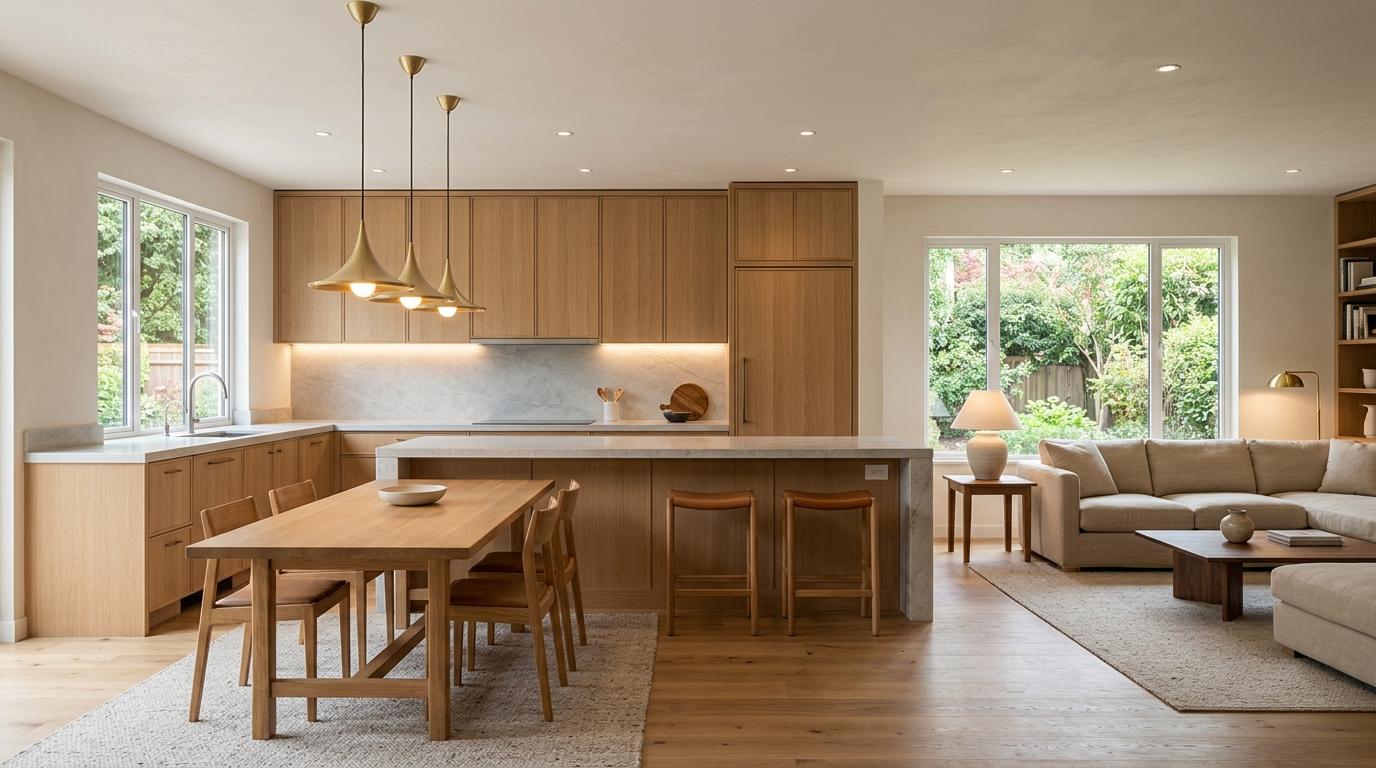

AI has changed how quickly people can generate design ideas, compare styles, and visualize possibilities. That speed can be genuinely helpful. But speed is not the same as judgment, and a beautiful image is not the same as a workable design plan. When clients ask whether AI can replace an interior designer, the better question is what each one is actually qualified to do well.
Why This Comparison Matters
AI has made design feel more accessible because it can produce room concepts in seconds. That appeals to homeowners and business owners who want ideas quickly, especially in the early stages of a project. The risk is assuming that visual output equals a complete solution. In real projects, the most important decisions are rarely about generating more options. They are about choosing the right option, understanding the tradeoffs, and carrying that decision through to a successful result.
Interior design is not just selecting finishes or arranging furniture on a screen. It involves function, circulation, scale, lighting, material performance, construction realities, and the way a space needs to support real life. That is where professional judgment matters most.
What AI Does Well
AI is strongest as a rapid idea-generation tool. It can help someone test aesthetic directions, explore color palettes, compare moods, and get unstuck when they are staring at too many possibilities. It is also useful for gathering references and translating vague preferences into something more visible.
That can save time at the beginning of a project. AI can help a client realize they prefer cleaner lines over ornament, warmer neutrals over cool grays, or layered textures over flat minimalism. Used properly, it can speed up discovery. The value is in exploration, not final authority.
Where AI Falls Short
AI does not understand your home the way a designer does. It does not walk the site, read the light correctly at different times of day, notice awkward circulation, measure existing conditions, or identify the construction constraints hiding behind a wall or ceiling. It can produce an attractive image that ignores code issues, budget reality, furniture scale, lead times, or how a family actually lives in the space.
It also tends to flatten nuance. Many AI-generated interiors look polished at first glance but fall apart under scrutiny. The layouts can be impractical, the material pairings unrealistic, and the details disconnected from how the project would actually be built. That gap matters, because poor decisions become expensive quickly once they move off the screen and into purchasing or construction.
What an Interior Designer Really Brings
A good interior designer brings discernment, not just decoration. The job is to solve problems before they become costly, awkward, or time-consuming. That includes space planning, finish selection, lighting strategy, material coordination, budgeting priorities, and aligning aesthetic goals with everyday use.
A designer also helps clients edit. That sounds simple, but it is one of the most valuable parts of the process. Most projects do not fail because there were too few ideas. They fail because there were too many disconnected ones, or because decisions were made without understanding the long-term consequences. A designer narrows the field, protects the integrity of the project, and keeps the result coherent.
The Difference Between Inspiration and Execution
This is where the comparison becomes clear. AI can inspire a room. A designer can execute it. Those are not interchangeable skills. Execution requires sequencing, coordination, technical understanding, and the ability to make hundreds of interdependent decisions without losing sight of the larger vision.
For example, a kitchen is not successful because the rendering looked luxurious. It is successful because the layout works, the clearances are right, the storage makes sense, the materials perform well, the lighting is properly layered, and the installation reflects good planning. AI can suggest a look. A designer helps make that look livable, buildable, and worth the investment.
When AI Is Useful in a Design Process
AI can be a helpful support tool when used with realistic expectations. It can speed up brainstorming, help clients communicate preferences, and make early conversations more productive. It is especially useful for people who struggle to describe what they want but can react well to visual prompts.
The strongest approach is usually to use AI as a supplement rather than a substitute. Let it help surface possibilities, then let professional design judgment filter those possibilities through function, budget, construction, and longevity. That combination can make the process more efficient without lowering the quality of the decisions.
When You Need a Real Designer
If the project involves remodeling, custom construction, meaningful investment, or rooms that need to function at a high level, a designer becomes far more important than an AI tool. The cost of weak decisions rises quickly when plumbing moves, millwork is custom, materials are expensive, or timelines depend on accurate coordination.
You also need a designer when the goal is not just a pretty room, but a well-resolved one. That means the space feels intentional, performs well, and holds up over time. AI can assist with ideas, but it cannot take responsibility for the decision quality behind the finished result.
The Better Question to Ask
Instead of asking whether AI is better than an interior designer, ask where AI adds value and where professional expertise is still essential. In most cases, AI is a tool for acceleration. A designer is a guide for judgment. Those are very different roles.
That distinction matters because clients do not just need more images. They need better decisions. The right designer helps you avoid expensive detours, prioritize what is worth investing in, and create a space that works beyond the first impression.
Final Perspective
AI will continue to improve, and it will absolutely remain part of the design conversation. But better technology does not eliminate the need for human expertise. It makes judgment even more valuable, because faster output increases the need for someone who can tell the difference between what looks convincing and what is actually right.
The most productive view is not designer versus AI. It is designer with the right tools, used at the right stage, for the right purpose. When that balance is handled well, technology can support the process. It should not be mistaken for the process itself.
Disclaimer: The content provided in this article is for informational purposes only and is not intended as financial, tax, or investment advice. JL Coates is not a financial advisor, tax consultant, or investment specialist. We recommend consulting with a professional financial advisor, tax specialist, or investment advisor to discuss your specific circumstances before making any financial, tax, or investment decisions based on this information. JL Coates assumes no responsibility for any actions taken based on the information provided in this article.